Banking & Finance · Digital Transformation · 2020 to 2022
Qatar Development Bank
Project LEAP: reinventing a national development bank, people first
What I owned
- Product strategy
- UX strategy
- KPIs
- Research and testing
- Arabic / RTL experience
- Executive stakeholder alignment
- Delivery through MVP and launch
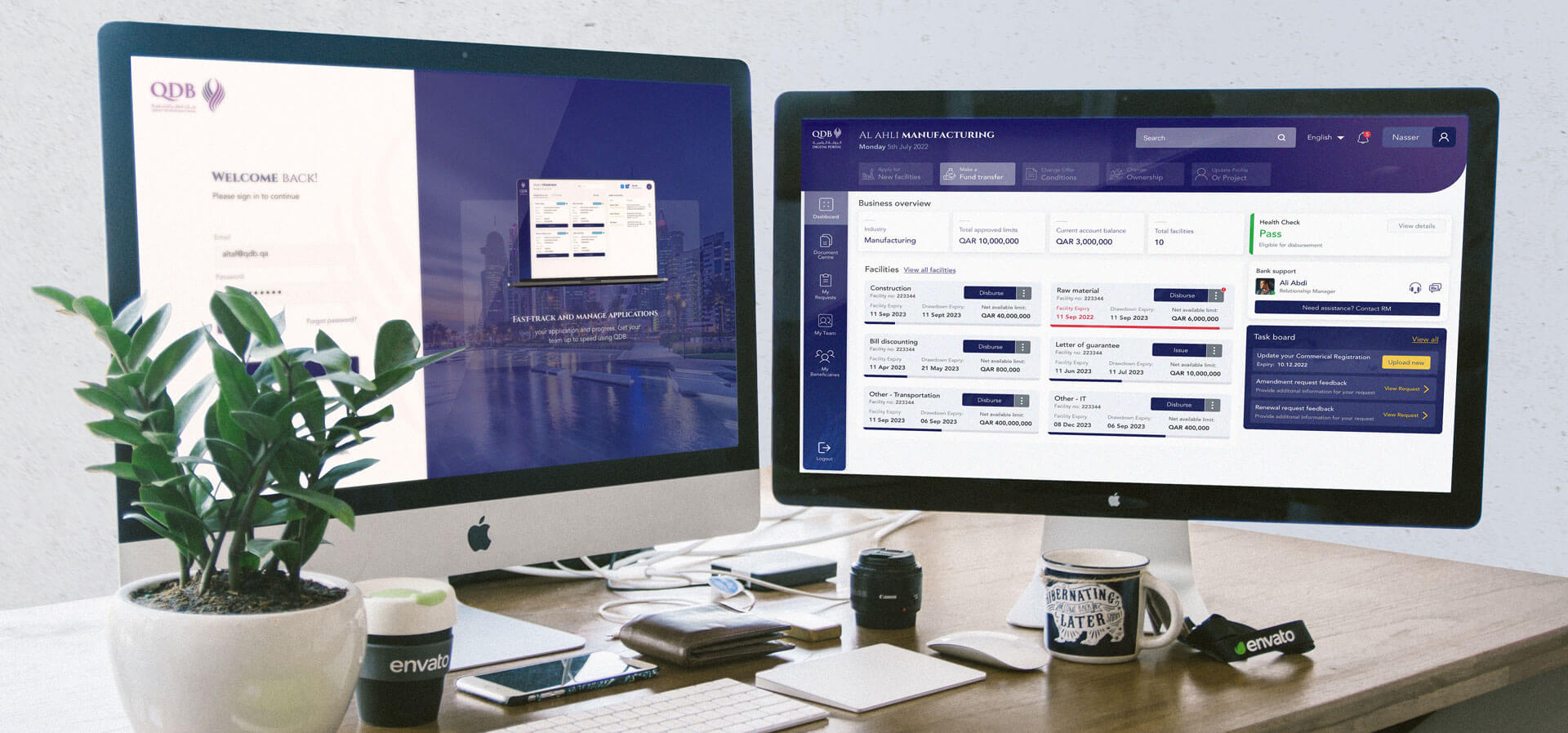
A national development bank, ready to LEAP
Qatar Development Bank provides loans, financial services and support that grow Qatar's industrial, tourism, education, healthcare, agriculture and fisheries sectors. It has 500 to 600 employees and a central role in the country's Vision 2030.
Project LEAP set out to digitally reinvent QDB, with a vision ambitious enough to make it the digital lighthouse of the region and the gold standard for digital experiences.
What LEAP had to deliver
Digital vision
An inspiring, transformative digital vision that improves the whole customer experience.
Roadmap for the future
A five-year roadmap for the tools, infrastructure and capabilities transformation needs.
Integration of initiatives
Existing and planned initiatives brought together into one coordinated approach.
In-house expertise
A core team of practitioners upskilled to drive the transformation from inside.
Simplify banking without slowing it down
The hardest problem wasn't the interface. Internal teams believed every existing step was essential, even the redundant ones, and that any simplification would increase turnaround time. The bank was full of talented, motivated people, but their efforts were held back by how the organisation worked.
Process as protection
Complex approval steps were seen as the only safe way to process an application.
Delivery blockers
Process, SDLC, organisational structure, tooling, funding models and no continuous delivery all slowed change down.
Paper felt safer
Traditional paper methods were trusted as more secure and reliable than anything digital.
Digital felt like a threat
Fears that digital would be hacked, that less digital staff would lose their jobs, and that customers would rather visit a branch.
Lead design across the product and the organisation
I was Product Strategist and UX Design Lead on Project LEAP, working between Vienna and Doha. Our design chapter had two parts: a Discovery team bringing the customer's voice into everything the bank did, and an Action team bringing industry best practice and simplifying existing processes.
Worked with
- Project lead
- UX design lead
- Service design consultant
- CX and research
Product and UX strategy
Led strategy for QDB Digital, the bank's digital portal, across the full lifecycle from research and design through MVP and launch.
Bilingual by design
Delivered Arabic (RTL) and English experiences as one product, not a translation.
Measured outcomes
Defined the KPIs for onboarding and engagement, and used research, usability testing and A/B tests to steer decisions.
Executive alignment
Worked with executive stakeholders on regulatory and business alignment as the bank changed how it worked.
Change the culture, then the product
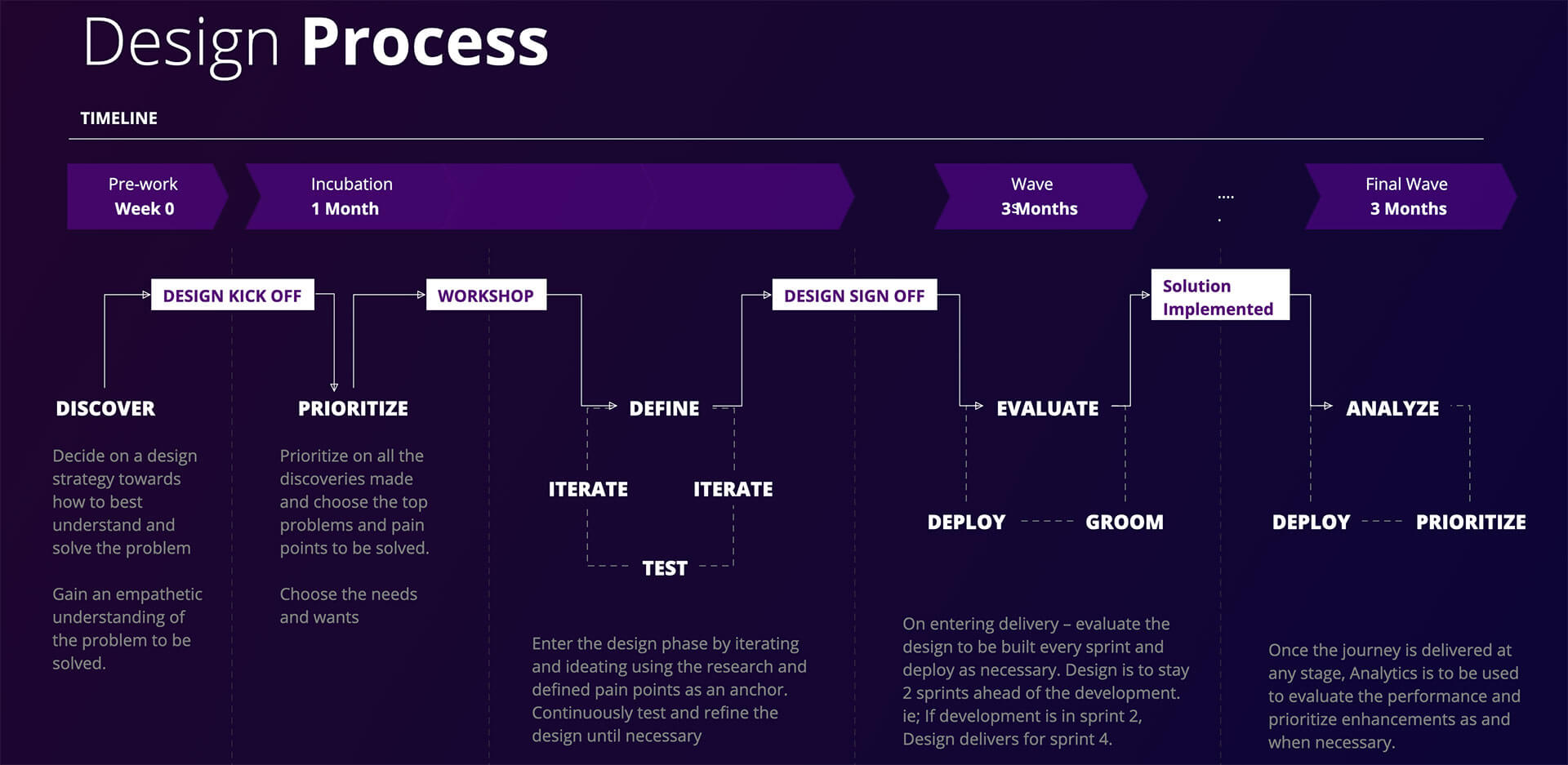
We began with a detailed baseline examination: what worked, what didn't, where best practice had broken down. Blockages were mapped and triaged into priority fixes before a single screen was designed. Then we delivered in waves, with design always ahead of development.
Changing thoughts
Workshops on mixing traditional and digital ways of working, digital learning sessions, cyber security knowledge transfers and remote working helped ease inhibitions across the bank.
Metrics over gut feel
Metrics across the whole SDLC replaced opinion with evidence and gave stakeholders a transparent view of progress.
- Pre-work · week 0
- Design kick-off
- Discover: choose the design strategy and build empathy with the problem
- Incubation · 1 month
- Prioritise the top problems, needs and wants
- Workshops, then define, iterate and test
- Design sign-off
- Waves · 3 months each
- Evaluate each sprint's design, deploy and groom
- Design stays two sprints ahead of development
- Final wave · 3 months
- Analyse performance with analytics
- Deploy and prioritise enhancements
The ability of an organisation to adapt rapidly, to quickly flex and meet market, environmental or internal changes, is absolutely critical to the future of innovation.
Head of Digital, Qatar Development Bank
Calls that shaped the transformation
Culture before product
We tackled fears about digital and broken processes first, because no portal would be adopted without that.
Two teams, one chapter
Separate Discovery and Action teams kept research and delivery connected, without one slowing the other.
Design two sprints ahead
In every delivery wave, design stayed two sprints ahead of development.
Metrics over gut feel
Measuring across the whole SDLC turned blocker conversations into evidence.
One portal for the whole customer journey
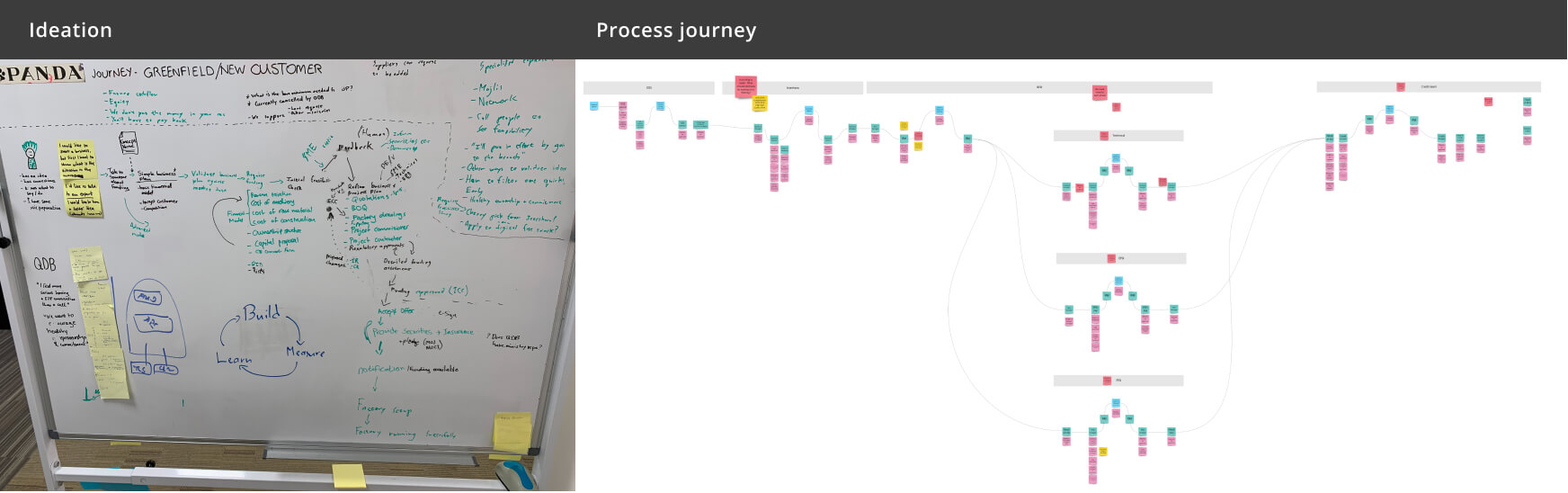
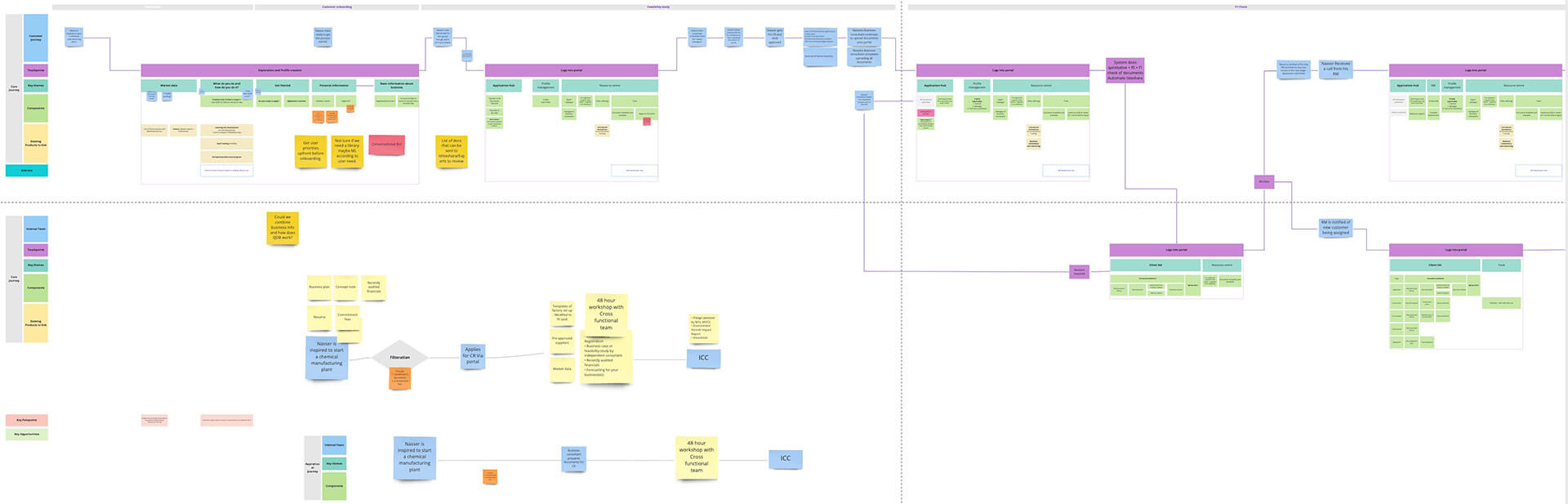
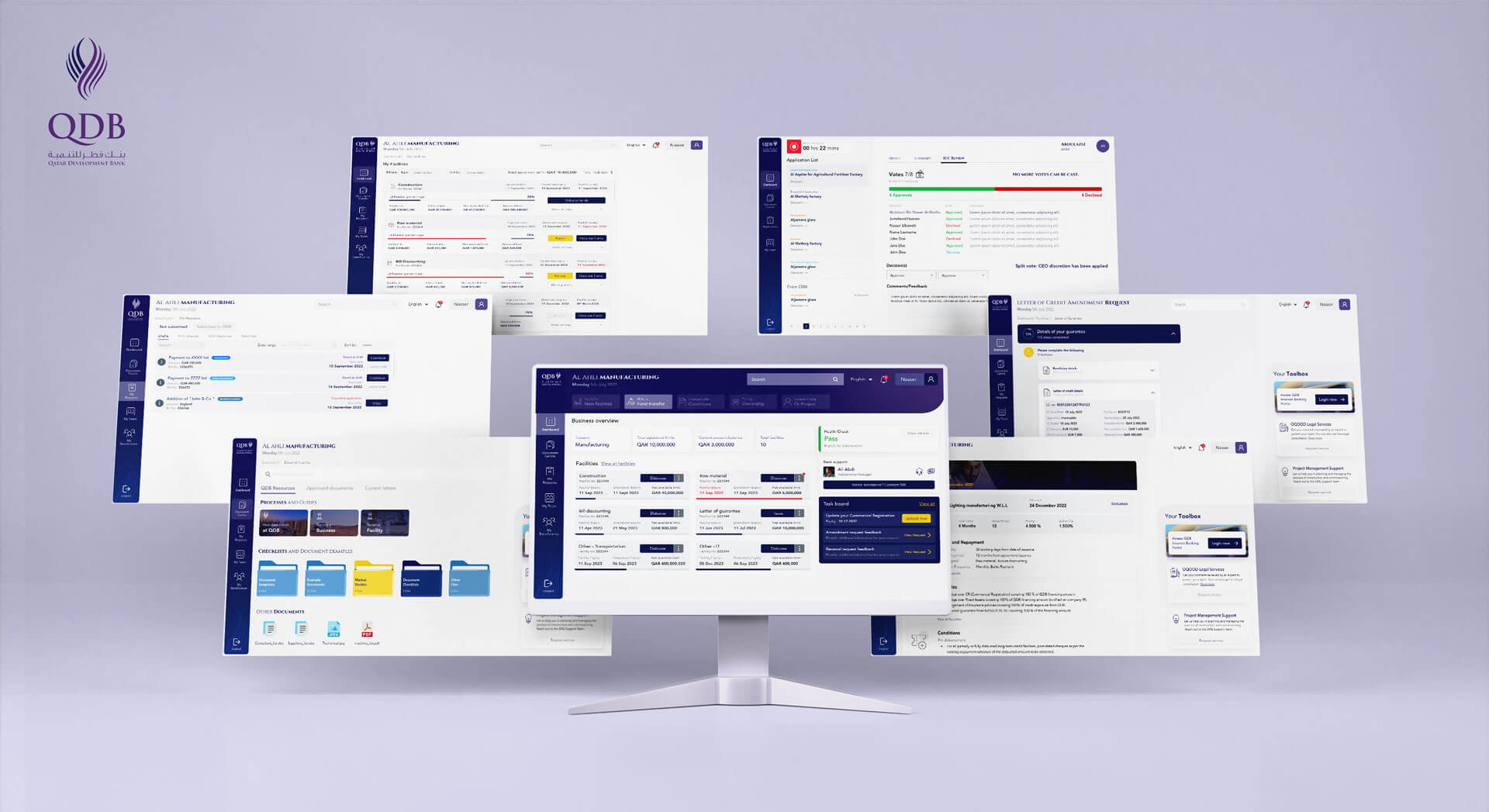
We mapped every journey end to end, for customers and for the internal teams who serve them, from a business owner exploring QDB for the first time through onboarding, feasibility study, financial checks and credit committee approval. Then we designed one portal to carry it.
Business overview
Approved limits, account balance, facilities and a health check in one view, so customers know where they stand.
Facilities and requests
Disburse funds, issue letters of guarantee, transfer funds and request changes without visiting a branch.
Task board and support
Pending actions in one place, with the customer's relationship manager a click away.
Document centre
Resources, process guides and document templates that make applications faster to complete.
Internal decisions
Credit committee reviews and voting moved online, so approvals no longer wait on paper.
Calm, clear and bilingual
A bilingual Arabic and English portal in QDB's colours, designed to make complex financing feel manageable for business owners.
A live portal and a bank that works differently
The portal launched as an MVP nine months after kick-off, in June 2021, and won over customers quickly. Just as important, teams across the bank's business, strategy and technology groups became iterative, adaptable and customer-focused.
Faster for customers
Turnaround time reduced by 84%, with 13 processes simplified.
Easy to use
80% ease of use, and 100% user retention after launch.
A new mindset
Teams now work iteratively, learning from failure to solve real problems.
Overall progress
70% of QDB's overall transformation achieved across digital, cultural and product.
Transformation is a people problem before it is a product problem. Starting small, proving value and bringing every team along did more for adoption than any feature we shipped.
Next project
Roche MEBMS →